Tuesday, September 1, 2015

Summer Program 8.7(Fri.) @ICHARM, Tsukuba

Hi. I am Genki. I cannot believe two weeks have passed since the beginning of the program. Time flies.

This was the final day of this summer program!

This day, the participants made presentations using all information and skills they’ve got during the summer program.
Some of the participants didn’t get much sleep in order to prepare their presentations.


They showed the result of geological analysis and analysis of assigned precipitation data and discharge data by using GIS tools, GCM data, IFAS, and so on. By using the results, each group gave their own suggestion of countermeasures. Every group showed the different kinds of results by making use of not only water-related knowledge, which was the main point of this program but also knowledge of other fields like economics and so on. We could see a big progress in the presentations compared to those on July 28.

During presentations, teachers played each role as river council or UNESCO and etc. The participants made presentations and answered to questions from teachers.

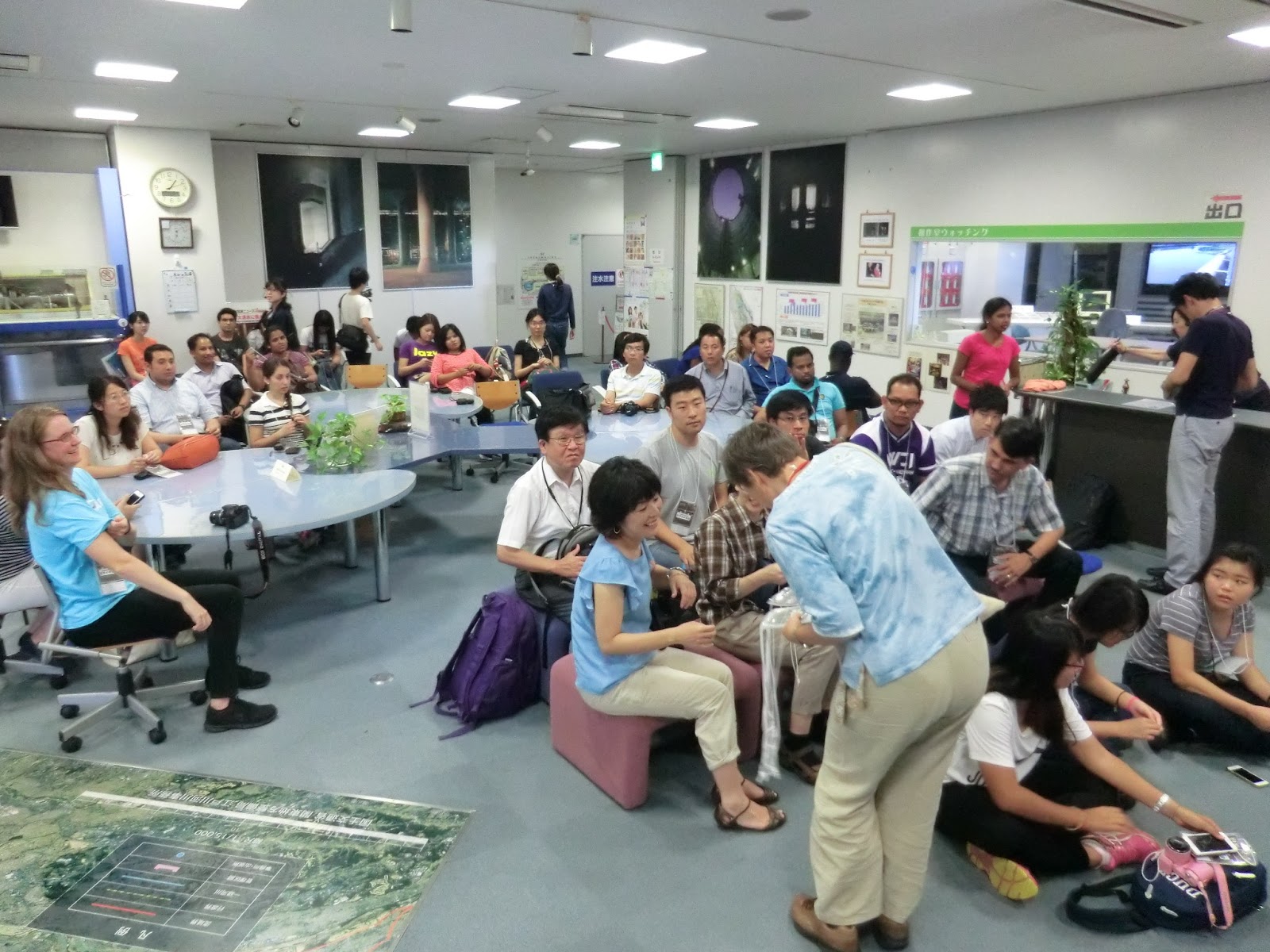
After finishing all the presentations, certificate ceremony and closing were done. All the participants looked happy and felt a sense of accomplishment.


After finishing all the presentations, certificate ceremony and closing were done. All the participants looked happy and felt a sense of accomplishment.

In the end, the participants had a reception and talked with each other very friendly. I hope they will be good friends forever!


After finishing the program, some of the participants went to the second party at Japanese style bar near Tsukuba station. I could hardly believe that they met together only two weeks ago.


This is all for the report of the summer program in 2015! I am sure this was a great time for all the participants.

Thank you for reading the report! I was really happy to be a part of this summer program!

Summer Program 8.6(Thur.) @ICHARM, Tsukuba

Hi. Genki is writing.

Third day in ICHARM.


There were two lectures this day about River Management in Tone River Basin from Mr. Kamoto and Consensus Building for Sustainable Water Management from Prof. Nasu, Kouchi University of Technology.


Other time the participants did group works for discussion and preparation for Final Presentation. Water resource Pampanga, flood and Their task was to show some countermeasures against flood for their assigned basins by using all the information they got from many lectures and skills like using GIS and IFAS which they got through the program.


Summer Program 8.5(Wed.) @ICHARM, Tsukuba

Hi. Genki is writing.

Second day in ICHARM has started!


The participants learned IFAS the day before, so this day was the time for Exercise and Hands-on, i.e. running IFAS system for the case basins (Bago in Myanmar and Pampanga in Philippines) for a flood event in past and future (using rainfall data downloaded from DIAS on last Saturday).


The participants did their works from 9 am to 5 pm or more and ICHARM staff also worked hard to help them.

Summer Program 8.4(Tue.) @ICHARM, Tsukuba

Hi. Genki is writing.

Here the participants arrived at ICHARM. Then welcome and introduction were done by Mr. Kamoto, Dr. Perera and Mr. Biswas, ICHARM.


After that they had a lecture on Social Science Approach to Water Related Disasters by Prof. Hayashi, DPRI (Disaster Prevention Research Institute), Kyoto University.


After lunch, Dr. Shibuo introduced Flood Modeling (IFAS (Integrated Flood Analysis System)) over three hours with 15-min break.


Summer Program 8.3(Mon.)@Japan Water Agency, Saitama city and the Metropolitan Area Outer Underground Discharge Channel, Kasukabe-city, Saitama Pref.

Hi. Genki's writing. This day the participants went to a facility in Kasukabe, which is my hometown. 

The latter part of the summer program was held by ICHARM in Tsukuba.

This was the moving day from Tokyo to Tsukuba, including an excursion to Japan Water Agency, Saitama-city and the Metropolitan Area Outer Underground Discharge Channel, Kasukabe-city, Saitama Pref.

In the morning, the participants had a lecture on Integrated Water Resources Management from the staff of JWA (Japan Water Agency) and NARBO (Network of Asian River Basin Organization). 


Mr. Ichihara lectured on Water Resource Utilization in Japan and Outline of IWRM. Mr. Kawasaki explained IWRM in Asia focusing on what was achieved by NARBO.


Then, they went to Kasukabe-city in order to see one of the cutting-edge flood control facilities in Japan. The facility which lets water from smaller rivers to larger river through huge underground channel in order to prevent flood was constructed in 2006. The participants had a small lecture on the facility and went inside the channel.


After seeing the facility, they took a bus for Tsukuba.

Summer Program 8.1(Sat.) @UTokyo, Hongo Campus

Hi. Genki's writing.

This was the last day in the summer program held by UTokyo.


They learned the importance of big data the last day. This day’s main topic was to learn how to use big data by themselves.


In the morning, Dr. Petra demonstrated the DIAS Tool handling the big data of the CMIP5 (Coupled Model Intercomparison Project Phase 5) output and the methodology of model selection and bias correction of precipitation data. Participants were having trouble with downloading data and some of the staff helped them handling their problems.


After lunch was the time for hands-on and group work, i.e. participants got the bias corrected data of the selected models for the target area for past and future analysis periods and then analyzed precipitation data of the past and the future using GIS skills for preparing the output.


Summer Program 7.31(Fri.) @UTokyo, Komaba Research Campus

Hi. Genki is writing again. 

Fifth day of the summer program was held in Komaba Research Campus, UTokyo.

In the morning, Assoc. Prof. Kawasaki introduced DIAS and Prof. Kitsuregawa lectured on the importance of big data and research of that field in Japan.


After lunch, they were separated into two groups and took lectures. One was by Prof. Koike, which showed them how DIAS is used. The other is by Assoc. Prof. Sekimoto and Dr. Akiyama, which also told them how to use big data especially individual GIS data.


This day’s last lecture was given by Assoc. Prof. Yokomatsu, who taught economic evaluation of natural disaster and mitigation policy.